
RESEARCH NOTE / PLATFORM HISTORY / NOVEMBER 2026
CD-i: a platform
looking for its audience.
What was the CD-i asking people to buy? A games console, an encyclopedia for the television, or a new way to watch and participate? I’m using its library and the language of its reviews to look at the distance between those promises and the experiences people found.
The familiar story is a failed system and a handful of notorious Nintendo-licensed games. That leaves a lot unexplored. The collection behind this note starts with 209 source-listed games and keeps multimedia, unreleased projects, and later releases separate. This is an exploratory historical reading, distinct from my ongoing study of games at their first anniversary.
A broader promise
The Netherlands Institute for Sound & Vision’s archival history reconstructs a product presented through education, reference works, entertainment, and familiar characters. It also documents uses in teaching and information kiosks. Those applications were part of the proposition, rather than distractions from a machine built only for games.
The question I find useful is whether that breadth gave households enough reasons to buy, or made the system harder to explain. The current data cannot estimate that effect. It can make the question more concrete by separating the software on offer and the qualities reviewers valued.
The library, with its boundaries intact
The baseline contains 209 games, with 53 multimedia entries, 10 unreleased projects, and 11 later releases held separately. It comes from an incomplete global source list, not a verified worldwide retail census. The atlas displays the primary games section. Reported years and credits remain source claims, and unknown fields stay unknown.
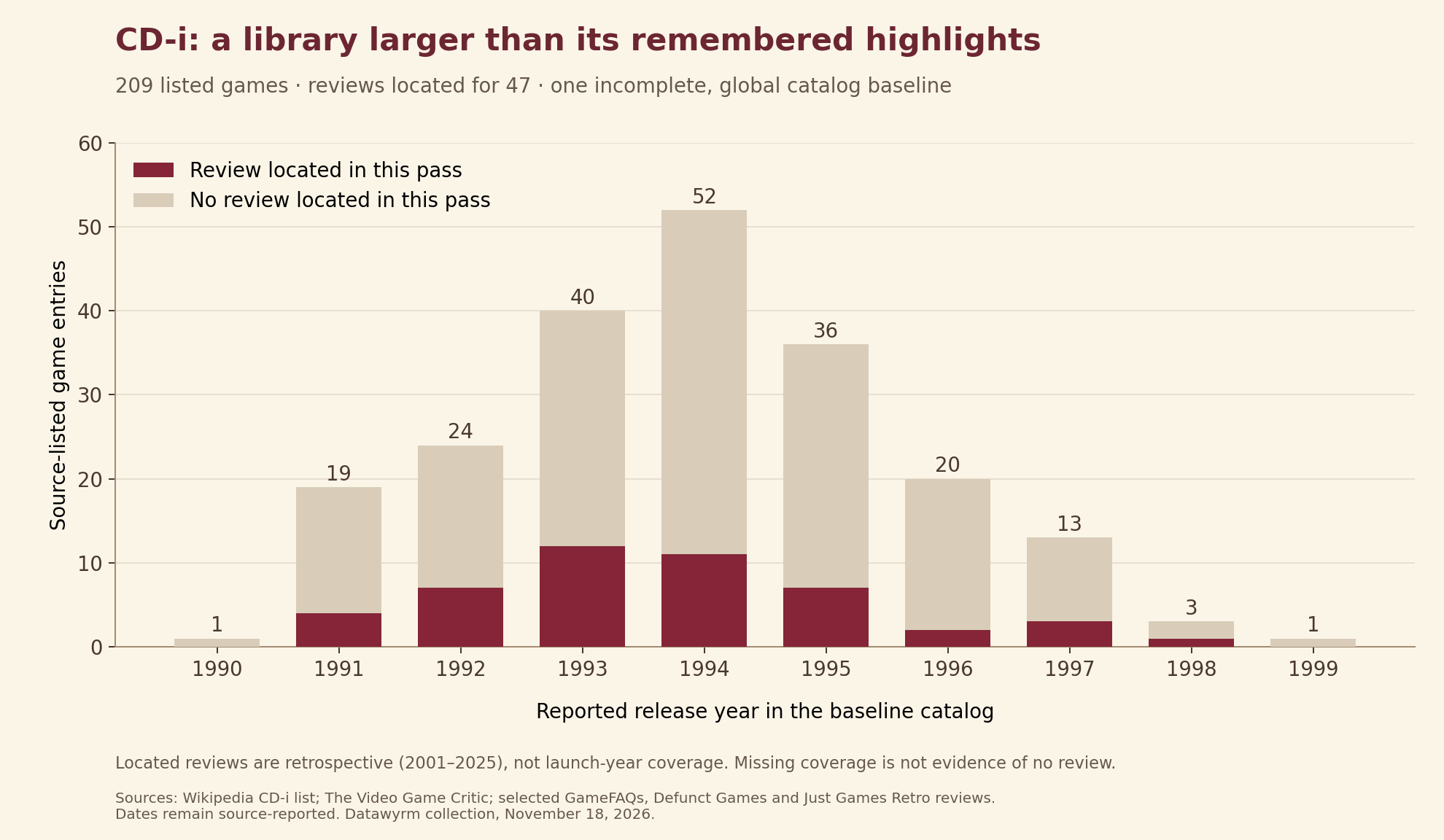
I located reviews for 47 of the 209 games (22.5%). A missing review here does not mean a game was never reviewed. The wider local collection contains 61 review records, including items outside the primary game section and two unresolved title matches. Most come from one retrospective editorial archive, so the count is not a count of independent critics.
Presentation and interaction were different questions
One recurring tension is the relationship between an impressive presentation and the pace of play. In its Clue / Cluedo review, The Video Game Critic contrasts “lofty production values but lousy playability.” The same archive gives NFL Instant Replay an A, praising the fit between watching video, making an officiating decision, and moving briskly through the interface.
That suggests a better question than whether full-motion video was a mistake: which designs made the video useful to what the player was doing? Burn:Cycle, The Apprentice, and Laser Lords offer different ways into that question.
| Game | Located assessment | Question to pursue |
|---|---|---|
| Burn:Cycle | VGC A−; two selected GameFAQs users: 10/10 and 2/10 | When does cinematic ambition outweigh a player’s reservations about the experience? |
| The Apprentice | VGC C; a positive Defunct Games review | How do craft, difficulty, and expectations change an overall judgment? |
| Christmas Crisis | VGC A− | What can a responsive platformer tell us about the range of experiences on this hardware? |
| Hotel Mario | VGC C+; selected GameFAQs reviews: 6/10 and 4/10 | What remains when the discussion moves from the cutscenes to controls and repetition? |
| Laser Lords | Positive, unscored Just Games Retro review | How do conversation, character presentation, and nostalgia shape a rediscovery? |
Burn:Cycle’s two user scores are deliberately shown as disagreement, not averaged. One writer values its narrative-led structure; another rejects much of its presentation and replay appeal. Two selected reviews cannot tell us how common either response was. They can help identify what deserves closer reading. The atlas links to the individual reviews and distinguishes user reviews from editorial assessments.
A sales figure is also a claim
The sales history needs the same care. Early-1995 reporting said Philips had passed one million players; July reporting said it had not. A later industry assessment again used the million threshold. Those are dated claims with different contexts, not interchangeable observations from a consistent sales series.
| Reported period | Claim | Scope and attribution |
|---|---|---|
| 1993-04-03 | About 100,000 players | Philips claim reported by Billboard worldwide; reported since fall 1991 |
| 1994-12 | About 850,000 players | ANP/Reformatorisch Dagblad reporting on Philips results worldwide, year-end 1994 per later report |
| early 1995 | About 1,000,000 players | John Hawkins statement reported by Willem Hoos, Billboard, April 15 1995 worldwide Philips CD-i players |
| 1995-07-27 | Fewer than 1,000,000 players | Philips CFO D. Eustace, reported by ANP/Reformatorisch Dagblad July 28 worldwide cumulative |
| 1996 | About 1,000,000 players | A. d’Aboville, EBU Technical Review, Winter 1996, printed p.40 scope ambiguous: discussion framed around Europe; total geography not explicit |
The 1993 Billboard report also attributes one million interactive discs to Philips. That figure mixes games, education, and children’s content. It is not one million game copies, and it tells us nothing reliable about the sales of an individual title.
I have not established defensible CD-i-specific unit estimates for individual games. Collector prices, production runs, PC-port sales, and hardware totals cannot stand in for that evidence. The atlas leaves game sales unknown rather than constructing a bestseller list.
What this changes about the story
My working interpretation is that CD-i brought together uses that did not all ask the same thing of a machine. A video-based sports quiz could benefit from qualities that did little for a conventional action game. An ambitious adventure could be memorable without being broadly appealing. Neither observation, on its own, explains hardware adoption.
I would develop this history by following three threads: who was being asked to buy CD-i, which designs fit the medium, and what remained interesting after its commercial ambitions receded. That keeps the games and their makers visible without turning later affection—or later ridicule—into evidence of what buyers thought at launch.
Reading the evidence
The located reviews are retrospective, dated 2001–2025. This is a purposive collection, predominantly in English, not a representative measure of reception. Contemporary magazine scans are a next step. Source years also disagree: the local reconciliation flags 20 specialist-archive version rows across 14 titles. Different versions and source errors remain possibilities.
Billboard and Digibron claims were checked through indexed reporting where direct access was unavailable. The EBU page was visually checked in the original PDF. The sources are kept distinct in the data. The public atlas includes brief original summaries and metadata, not a full-text review corpus.
Full CD-i method and attribution · Public CD-i data · Explore the library
Start with your question
This is how I approach a landscape: establish the comparison, inspect the language around it, and keep uncertainty in view. If your team is choosing reference games or trying to understand reception, tell me about the decision ahead.
Discuss a research project